A Technical Guide to Full-Grain Leather and Goodyear Welted Construction in Men's Leather Shoes
Two specifications decide how a pair of men's leather shoes performs over its working life: the grade of the leather and the way the upper is attached to the sole. Full-grain leather is the outermost, grain-intact layer of the hide. Goodyear welting is a stitched construction in which the upper is sewn to a welt, and the welt is sewn to the outsole — which is what allows the shoe to be resoled rather than replaced.
This guide breaks both specifications down component by component for buyers, brand owners and product developers evaluating men's leather shoes for business, formal and wedding programs. The specification references come from the manufacturing documentation of Yangjiang Hengxin Shoes Co., Ltd., a Guangdong-based manufacturer founded in 2011 that produces handmade men's leather shoes — Oxfords, Derbys, Monkstraps, loafers, casual shoes, sneakers, boots and sandals — with an annual output of 400,000 pairs and approximately 70% of production exported to the EU, USA, Canada, Africa, Asia and Australia.
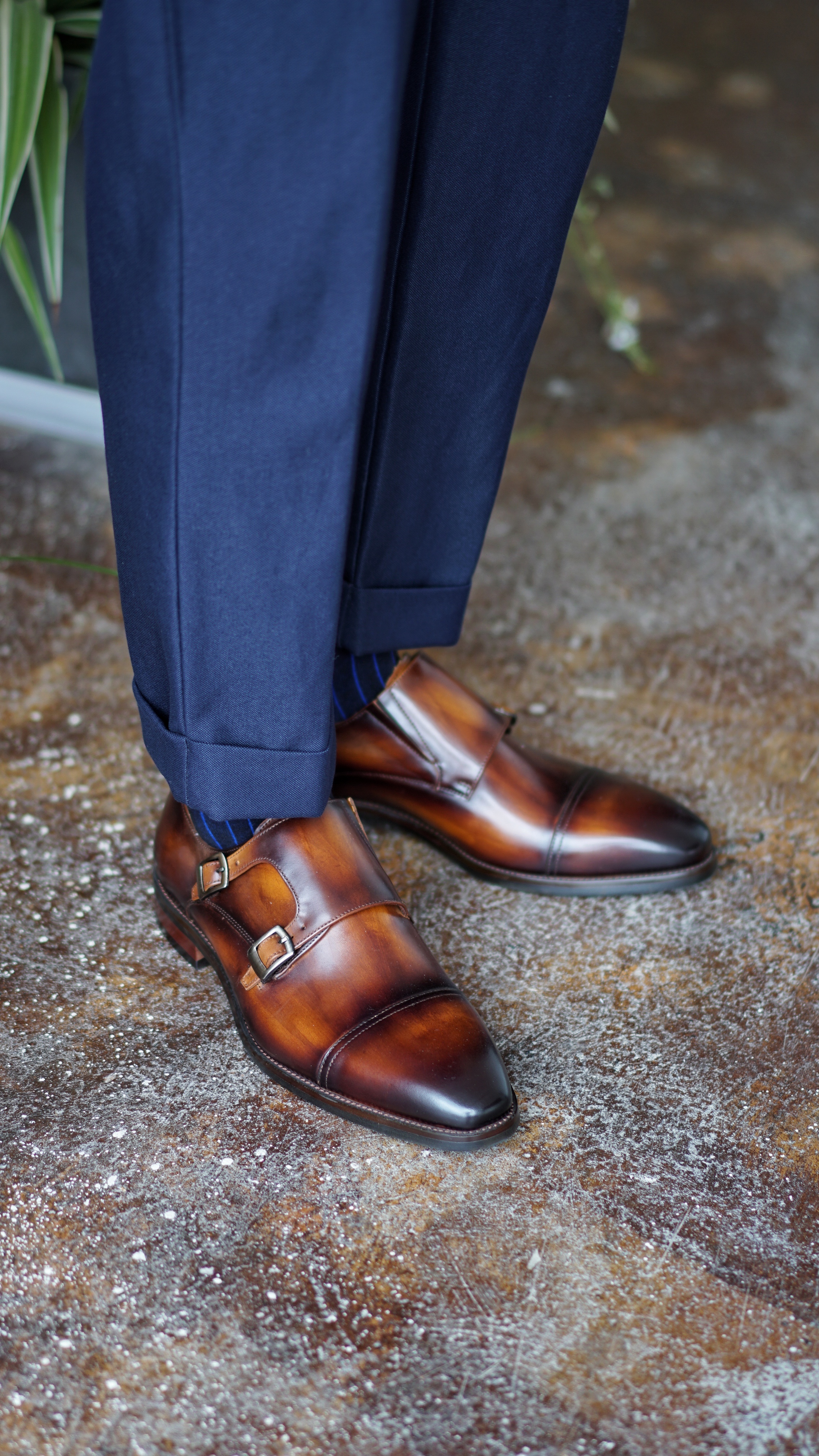
Handmade men's leather shoes built on a full-grain cow/calfskin upper with Goodyear welted construction (model F8-MK3, brown).
Problem Definition: Why "Genuine Leather" Is Not a Specification
A purchase order that specifies only "genuine leather men's leather shoes" leaves three of the four performance-critical components undefined. "Genuine leather" describes origin, not grade. It does not state whether the upper is full grain, corrected grain or split, and it says nothing about the lining, the insole or the outsole.
The second undefined variable is construction. A cemented shoe is glued; a Goodyear welted shoe is stitched. If the construction method is not written into the specification, a quotation for a cemented build and a quotation for a welted build can end up being compared as if they were the same product, when they are not.
These gaps surface later, under real wear. Documented operating conditions for men's leather shoes in office and business use include 8–12 hours of daily wear, repeated on-and-off cycles, long periods of walking and standing, and carrying through business travel. Breathability, insole shape retention and outsole attachment are the components that carry that load — and each of them is defined by material and construction choices made at the specification stage.
The practical fix is a component-level specification: upper grade and species, lining material, insole material, outsole type, and construction method. The rest of this guide works through each one in turn.
Industry Background: Why Specification Depth Is Now a Commercial Issue
The men's leather shoe category is large enough that specification choices carry real commercial weight. Grand View Research valued the global leather footwear market at USD 150.7 billion in 2024, with the male segment accounting for 54.1% of the total share.
Volume data points in the same direction. Men's leather shoe sales volume exceeded 780 million pairs globally in 2024, representing 41.3% of the total men's footwear industry (Industry Research). Asia Pacific held the largest revenue share of the leather footwear market in 2024, estimated at 53.9% (Grand View Research).
Within the category, formal shoes account for approximately 40% of total sales volume in the men's leather shoe market as of 2024 — the segment where full-grain uppers and welted construction matter most.
Two further shifts are relevant to buyers. Sustainable leather practices now account for approximately 28% of global leather production for footwear (2024), which increases the number of material-origin questions a supplier is expected to answer. And published market estimates differ between research houses — Spherical Insights places the leather footwear market at USD 137.3 billion for the same period — so any single market figure is best treated as directional rather than exact.
For a sourcing team, the implication is straightforward: vague leather claims are becoming harder to defend to end customers, to quality reviewers and to compliance reviewers at the same time.
Detailed Solution: The Five Specifications That Define the Build
1. Upper — Full-Grain Cow and Calfskin
Full-grain leather is cut from the outermost layer of the hide with the grain surface left intact. The natural pores and the dense fibre structure just below the surface are preserved rather than sanded away or hidden under a heavy finish. In the documented men's leather shoe specification, the upper is full grain cow/calfskin.
Sourcing matters as much as terminology. The range uses premium Italian and Argentinian leathers, and upper finishing includes hand-coloured patina refined through three iterations of technological innovation — from the original brushed patina to the washing and spot-colour techniques used today.

Full-grain cow/calfskin upper, full-grain cow leather lining and insole, rubber or leather outsole (model F8-MK3, coffee).
2. Lining and Insole — Full-Grain Cow Leather
The specification continues inside the shoe: the lining and insole are full grain cow leather. This is the part of the build that determines how the shoe behaves across an 8–12 hour working day. A leather lining manages moisture inside the shoe and conforms to the foot over time, while a leather insole holds shape and can be conditioned through its service life. Synthetic and coated linings behave differently under sustained wear, so lining and insole material should be named in the spec sheet rather than left to the factory default.
3. Outsole — Rubber or Leather
The product specification lists both rubber outsole and leather outsole as available options on the same handmade construction. The choice is a market and formality decision, not a quality ranking.
Rubber outsoles are generally chosen where traction on wet or uneven surfaces matters more than traditional formality — commuting, outdoor business activity and mixed-weather markets. Leather outsoles remain the traditional pairing for formal Oxford and Derby programs, including wedding and evening wear, where a slimmer profile and a leather sole edge are expected; they typically wear faster on abrasive pavement and benefit from more frequent sole care.
Because both options are documented in the same product specification, the outsole can be selected per order rather than fixed by the factory.
4. Goodyear Welted Construction — The Stitching That Enables Resoling
Goodyear welting is a stitched construction: the upper and insole are sewn to a welt, and the outsole is then sewn to that welt. Because the outsole is attached by stitching rather than by cement alone, it can be replaced when it wears out, without rebuilding the upper.
Goodyear welted construction is the core specialization of the Hengxin line, which combines precision stitching with premium materials across Oxfords, Derbys, Brogues, Monks and Loafers.
Cemented construction, by contrast, glues the upper to the outsole. It can be lighter and is faster to produce, but resoling options are limited once the bond and sole unit are worn. Neither method is universally better; the point is that the specification should state which one the quoted price refers to.
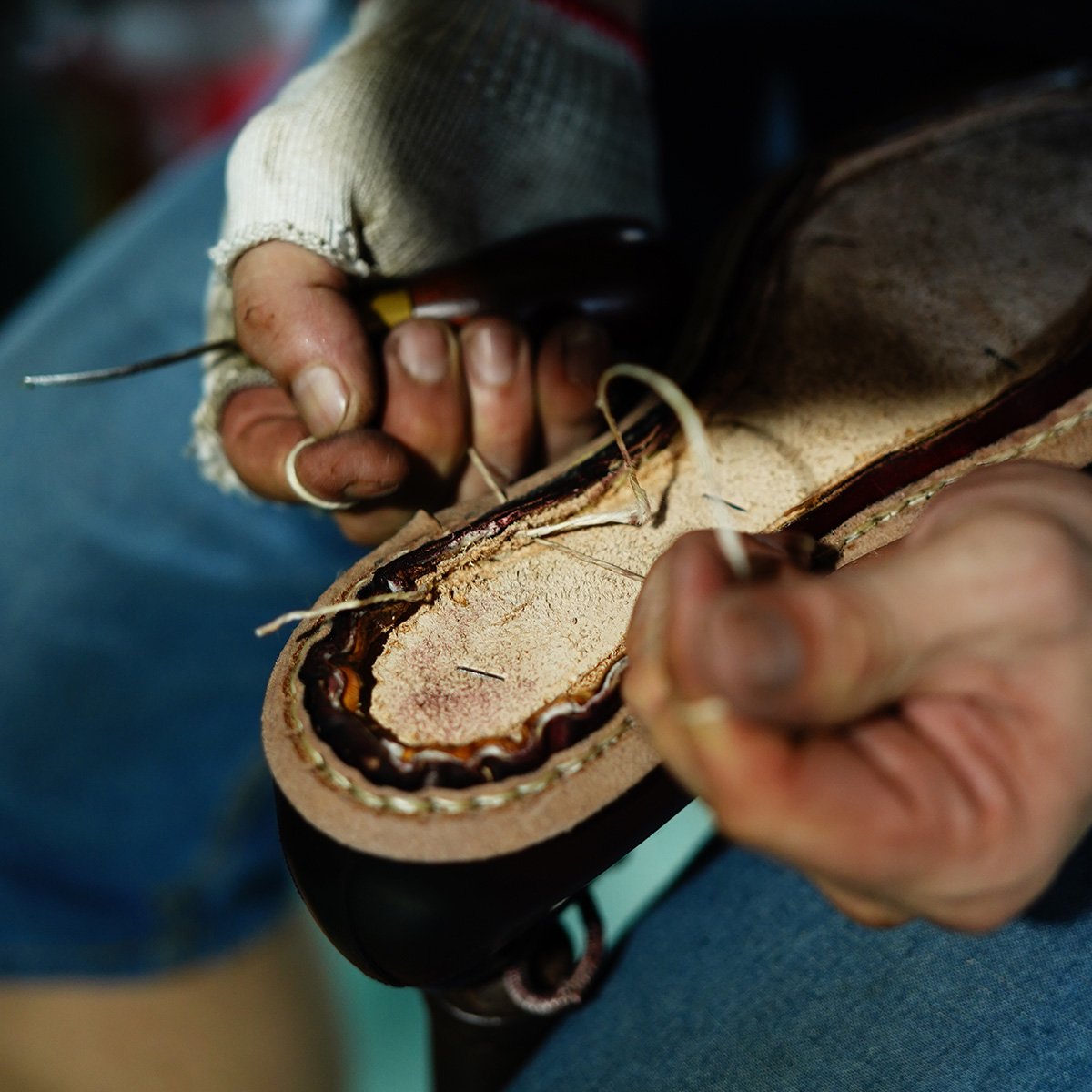
Goodyear welted construction: the upper and insole are stitched to a welt that carries the outsole.
5. Style and Model Coverage
Handmade men's leather shoes in this specification are produced across the main men's categories: Oxfords, Derbys, Monkstraps, loafers, casual shoes, sneakers, boots and sandals. Documented models that use the full-grain upper, full-grain cow lining and insole, and rubber or leather outsole combination include F8-MK3, F8-NS58 and M205-B02, all described as hand made men's leather shoes for business men, office men and wedding men.
Step-by-Step Breakdown: How a Goodyear Welted Shoe Is Built
- Specification and last engineering. The buyer's requirement becomes a last, a pattern and a size run. Development work is supported by an independent sample room and a professional shoe design team working with international fashion experts, together with OEM/ODM one-stop services covering last-making, alterations and repairs.
- Leather selection and cutting. Full-grain cow/calfskin is inspected and cut so that the grain surface is positioned on the most visible panels of the upper.
- Upper closing. Panels are stitched into the upper. Precision stitching at this stage is what makes welted construction possible later in the line.
- Lasting. The closed upper is pulled over the last and held in shape.
- Welt stitching. In the Goodyear process, the upper and insole are sewn to the welt that will carry the outsole.
- Outsole attachment. The rubber or leather outsole is attached through the welt, so the sole is mechanically connected to the upper rather than only bonded to it.
- Finishing. Hand-coloured patina is applied and worked through staining and brushing, based on a process refined across three iterations of technological innovation.
- Quality control. Production follows 100% quality control, with inspection carried out before packing.
- After-sales readiness. Free maintenance and repair are offered, along with returns and exchanges for quality issues.
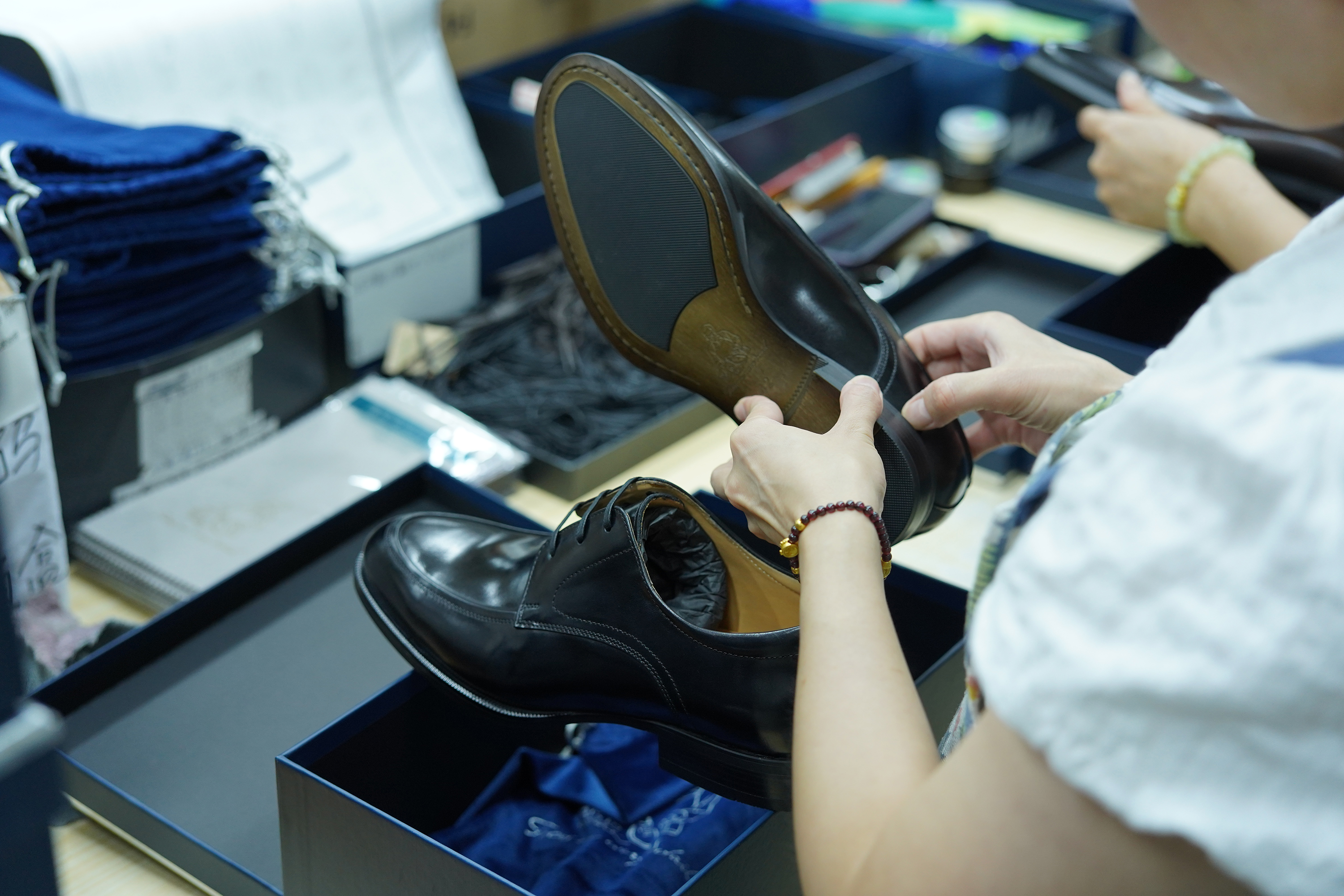
Inspection stage: production runs under 100% quality control before shoes are packed.
Use Cases: Matching the Specification to the Project
Business and office programs
Documented end users are business men, office men and wedding men. Working conditions include indoor office environments and outdoor business activities, with daily wear of 8–12 hours, repeated on/off cycles, long periods of walking and standing, and business travel portability. Accessories that support the lifecycle of a full-grain welted shoe include shoe trees for shape retention, leather conditioner and polish, a shoe horn for easy wearing, and a waterproof spray protector.
Wedding and formal programs
Wedding shoes are a documented application for this construction. The same full-grain upper and welted build used in business programs carries into formal events, where finish consistency across a size run and a slim sole profile are the primary selection criteria.
Retail and distribution
Suit shops selling and leather shoe distribution are documented project types. One Canadian men's clothing store has ordered 2,000 pairs for online and physical shop sales, with repeat orders for five consecutive years and zero returns; the stated reasons were reasonable prices, high quality and excellent after-sales service.
Export-market fit
Application data covers US, CA, ZA, NG, AE and AU, which aligns with the wider export mix of EU, USA, Canada, Africa, Asia and Australia — markets where both rubber and leather outsole variants are ordered depending on climate and formality expectations.
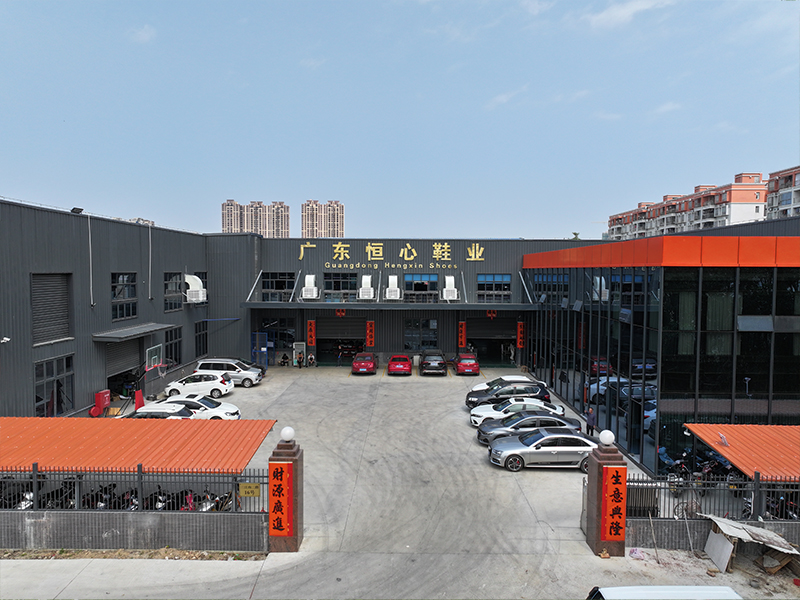
Yangjiang Hengxin Shoes Co., Ltd., Guangdong, China — 5,000㎡ facility and 400,000-pair annual output.
Comparison Table: Documented Specification and Outsole Selection
| Component | Documented material or method | What it means for the buyer |
|---|---|---|
| Upper | Full grain cow/calfskin | Grain surface left intact; the grade can be named and verified in the specification |
| Lining | Full grain cow leather | Moisture behaviour inside the shoe across an 8–12 hour wear day |
| Insole | Full grain cow leather | Shape retention and long-term comfort when conditioned |
| Outsole | Rubber outsole or leather outsole | Market- and formality-driven choice; both available on the same construction |
| Construction | Goodyear welted | Stitched attachment that permits resoling instead of replacement |
| Selection consideration | Rubber outsole | Leather outsole |
|---|---|---|
| Grip on wet or uneven surfaces | Generally higher | Lower when wet; best suited to dry conditions |
| Formality and profile | More common on commuter and casual builds | Traditional pairing for formal Oxford and Derby programs |
| Wear and maintenance | Typically more abrasion-resistant on pavement | Wears faster; benefits from regular sole care |
| Resoling | Replaceable when attached to a welted shoe | Replaceable when attached to a welted shoe |
| Availability | Documented option in the product specification | Documented option in the product specification |
FAQ
Which standards and quality controls apply to men's leather shoe production?
ISO 9001:2015 is the primary international quality management system standard adopted by leather footwear manufacturers for process consistency (ISO TC/137 Footwear). Factory-level controls are separate from certification: documented production practice for this range runs under 100% quality control, with inspection before packing. Buyers should confirm certification status for the specific production site named in a quotation rather than inferring it from a product listing.
Can full-grain leather and Goodyear welted construction be produced at volume?
Yes. Yangjiang Hengxin Shoes Co., Ltd. operates a 5,000㎡ facility with approximately 100 employees and an annual output of 400,000 pairs, supported by OEM/ODM and private label customization. The portfolio includes more than 500 bespoke styles, and development work is handled through an independent sample room and a professional design team.
What drives the cost of a full-grain Goodyear welted men's leather shoe, and what is the MOQ?
The main cost drivers are the leather grade and origin — full grain cow/calfskin, including premium Italian and Argentinian leathers — the number of hand-finished patina steps, the outsole type, and order volume. MOQ ranges from 60 to 300 pairs depending on the design. Because these variables move independently, cost should be quoted against a fixed component specification rather than a style name alone.
How does sample validation work before a bulk order?
Sampling takes place in the factory's own sample room. The OEM/ODM one-stop service covers last-making, alterations, repairs and sample customization, which lets a buyer validate last fit, leather, colour and construction before committing to bulk production. Sample approval is the practical control point for full-grain grade and welted construction, because both are visible and verifiable on a physical sample.
What production lead time and after-sales support should a buyer plan for?
The documented OEM/ODM lead time is 40–60 days. After-sales support includes free maintenance and repair, plus returns and exchanges for quality issues. For a project-specific schedule, confirm the timeline with the factory's sales contact before placing the order — Rose, General Sales Manager, at rose@dressshoefactory.com, or via WhatsApp at +86 158 2050 2754.
Conclusion
Full-grain leather and Goodyear welted construction are specification decisions, not marketing terms. Full grain describes the grade of the upper — grain intact, no surface removal — and in this build the same grade continues into the lining and the insole. Goodyear welting describes how the shoe is held together: upper sewn to welt, welt sewn to outsole, so the outsole can be replaced instead of the shoe being discarded when the sole wears through.
A short specification checklist covers most of the sourcing risk: name the leather grade and species; name the lining and insole material; state whether the outsole is rubber or leather; state the construction as Goodyear welted; confirm the quality-control process; agree MOQ and lead time in writing; and confirm after-sales terms.
Yangjiang Hengxin Shoes Co., Ltd. manufactures to this specification in Guangdong, China, with a 400,000-pair annual output and a documented OEM/ODM scope that runs from last-making through sample customization and after-sales repair. Full details are available at dressshoefactory.com.
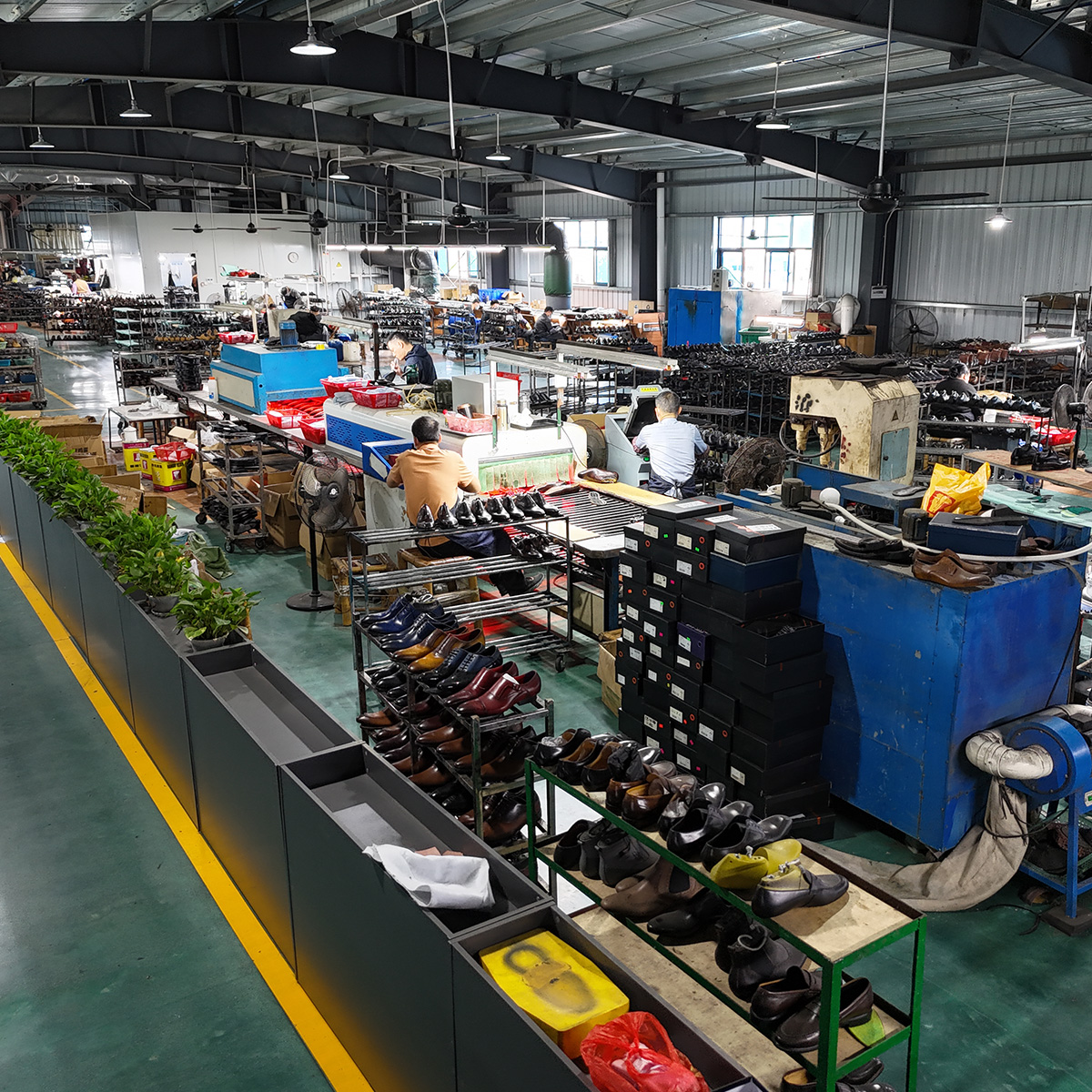
OEM/ODM production line for handmade men's leather shoes — sample customization through bulk delivery.
Next step: sample, quotation or catalog
Send your component specification — leather grade, lining and insole material, rubber or leather outsole, and Goodyear welted construction — and the factory will respond with a quotation, a sample plan and a production timeline.
Email: rose@dressshoefactory.com | WhatsApp: +86 158 2050 2754 | Website: dressshoefactory.com
Have Questions or Need More Details?
Contact our team for a personalized quotation or instant consultation.
Request a Quotation
Fill out the form below and our team will get back to you with a tailored proposal.
WhatsApp Direct Chat
Prefer to chat in real-time? Message us on WhatsApp for instant assistance & quick answers.
- Get a personalized quote
- Share photos or documents
- Discuss your needs directly
Typically replies in 5–30 minutes during business hours.