
Goodyear Welted Construction Explained: Basic Concepts Behind Men's Leather Shoe Quality
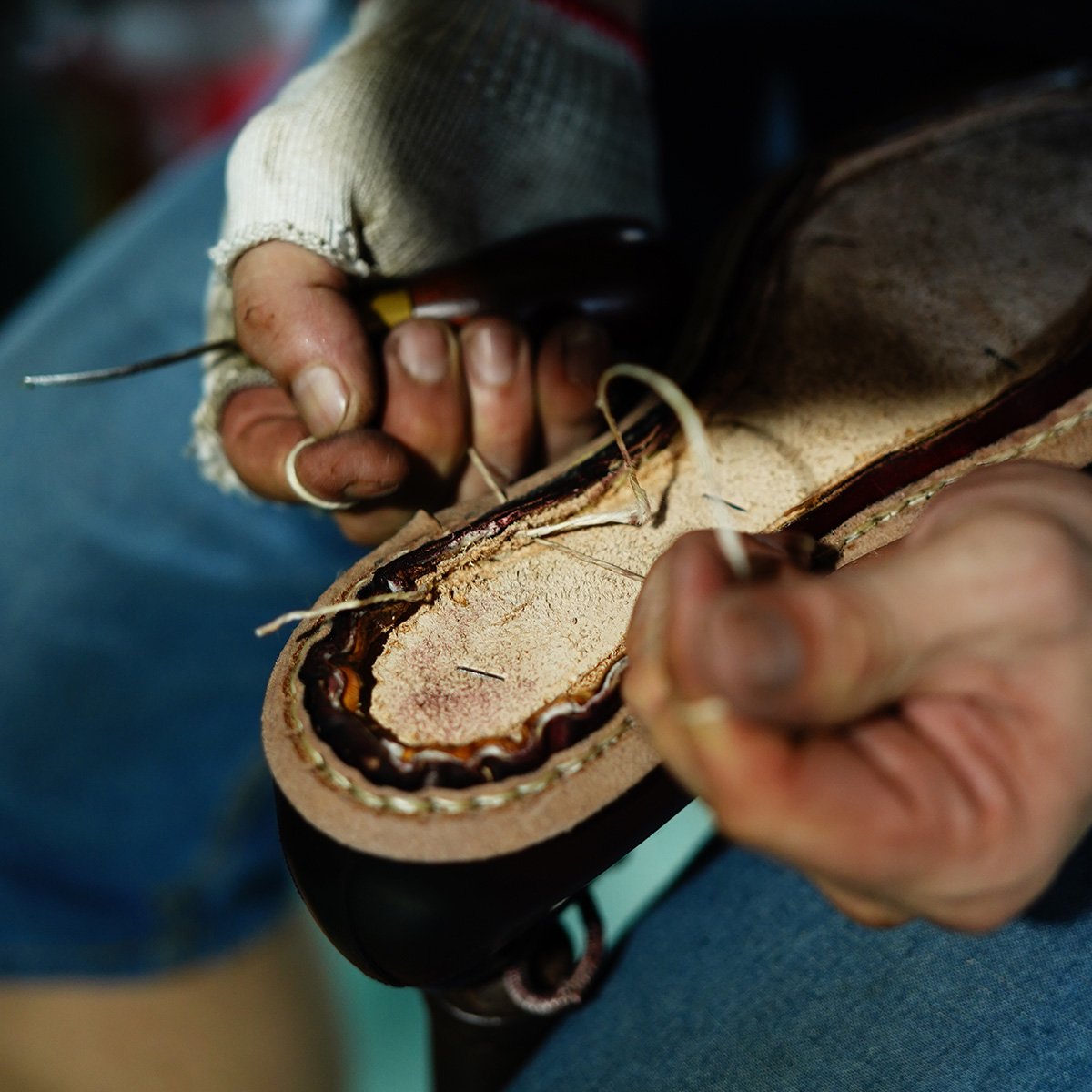
Goodyear welted construction: the welt seam that connects the upper, the insole and the outsole.
Goodyear welted construction is a shoe assembly method in which a narrow strip of leather — the welt — is stitched to the upper and to the insole, and then stitched again to the outsole. The shoe is held together by thread rather than adhesive alone. That single mechanical detail is why a welted men's leather shoe can be resoled and kept in rotation for years, while a cemented shoe is normally replaced once the sole wears through.
Buyers who are new to the men's leather shoe category meet the term "Goodyear welted" on product pages and price lists long before anyone explains it. This article defines the construction, separates it from cemented and mass-produced assembly, and breaks the shoe into the four structural layers that actually determine quality: upper, lining, insole and outsole. It uses the verified build of three current models from Yangjiang Hengxin Shoes Co., Ltd. — M205-B02, F8-NS58 and F8-MK3 — to show how those layers are specified in production, and closes with the questions buyers ask most often before a first or repeat order.
Why Men's Leather Shoe Quality Is Hard to Judge From the Outside
The parts of a men's leather shoe that a buyer can inspect in a showroom are the parts that wear out last. Colour, shine, grain pattern and surface stitching are finish-level features. The features that decide whether the shoe survives five seasons sit under the foot and inside the shoe, where no buyer can see them.
Three practical problems follow from that:
- Visible quality is cosmetic. A well-polished shoe with an evenly coloured finish can still be built on a thin, glued structure.
- Structural quality is invisible. The lining, the insole and the way the outsole is attached are not visible without dismantling the shoe.
- The vocabulary is not standardised. Words like "handmade", "premium" and "luxury" describe positioning, not a defined technical specification. Two pairs produced in the same building can carry the same words and be built two different ways.
For distributors, private-label owners and procurement teams, the consequence is measurable. Construction drives return rates, warranty claims and end-of-life complaints — and it decides whether an end customer can repair a pair or has to buy a new one. Repair-friendly construction is one of the few quality features that keeps a buyer coming back to the same product line.
The Market Context Behind Construction Choices
Construction decisions are made inside a large and competitive category. According to market research published by Vertex and distributed through ResearchAndMarkets, the global men's leather shoes market is projected to expand from USD 61.08 billion in 2025 to USD 78.69 billion by 2031. On the demand side, the Observatory of Economic Complexity reports that the United States imported USD 11.6 billion of leather footwear in 2024, mainly from Vietnam (USD 3.68 billion), China (USD 2.42 billion) and Indonesia (USD 1.18 billion).
Two implications matter for buyers. First, supply is deep and highly substitutable, which pushes manufacturers to compete on price. Second, in a market of that size, the differences that survive price pressure are the ones that are hard to copy quickly: skilled construction, material specification and repair support. That is the context in which Goodyear welted construction remains relevant — not as a decorative claim, but as a build method with a serviceable life cycle.
What Goodyear Welted Construction Actually Is
Goodyear welted construction creates a mechanical link between four components. The upper is pulled over a last and stitched to a leather strip, the welt. The welt is stitched to the insole at the same time. A filling material is used to level the base, and the outsole is then stitched to the welt. The result is a shoe assembled along a continuous thread path rather than bonded with adhesive.
The practical benefit appears at the end of the first sole's life. Because the outsole is stitched to the welt, a workshop can cut those stitches, lift the worn sole away and stitch a new one to the same welt, without pulling the upper apart. This is what makes a welted shoe a repairable asset rather than a disposable one — and it is the reason welted construction is associated with formal footwear intended to be worn for years.
What welted construction is not
- It is not a leather grade. A welted shoe can be built with different upper qualities, and a full grain upper can also be used on a cemented shoe. Construction and material are separate decisions.
- It is not a water-resistance feature. Leather should not be exposed to water, because moisture can cause the colour to fade. If a pair does get wet, the correct response is the same regardless of construction: dry it with a dry cloth as soon as possible and maintain it with regular colour-protection care.
- It is not the only stitched method. Other stitched constructions exist. The welt is what distinguishes the Goodyear method: a separate leather strip that can be re-used when the sole is replaced.
The trade-offs are also real. A welted shoe carries more layers under the foot, so it is typically heavier and needs a break-in period before it moulds to the wearer. It also requires more operations and more skilled labour than a cemented build, which is reflected in unit cost. Buyers should treat welted construction as a specification with a cost and a service life, not as a universal upgrade.
The Anatomy of a Men's Leather Shoe: Upper, Lining, Insole and Outsole
Four layers decide how a men's leather shoe performs. Each one has a different job, and each one can be specified precisely in a purchase order.
Upper
The upper is the visible outer layer — the part that carries the shape, the finish and the style. Full grain leather keeps the outer surface of the hide intact, which is why it is the reference material for formal and luxury men's leather shoes. The models M205-B02, F8-NS58 and F8-MK3 use a full grain cow or calfskin upper.
Lining
The lining is the inner layer that sits against the foot and against the sock. It shapes how the shoe feels on the inside and how it ages with wear. A leather lining is a structural and comfort specification, not a cosmetic one. The same three models specify a full grain cow lining.
Insole
The insole is the foundation layer under the foot, and in welted construction it is load-bearing: the upper and the welt are stitched to its edge. If the insole is weak or poorly prepared, the whole assembly loses its shape. The insole on M205-B02, F8-NS58 and F8-MK3 is specified as full grain cow leather.
Outsole
The outsole is the ground-contact layer and, in a welted shoe, the component that is stitched to the welt and later replaced. Rubber and leather are the two standard options. A rubber outsole is generally chosen for grip and wet-weather use; a leather outsole is generally chosen for a slimmer, more formal profile. Outsole choice is the main variable across the three models described here — the upper, lining and insole specification is consistent.
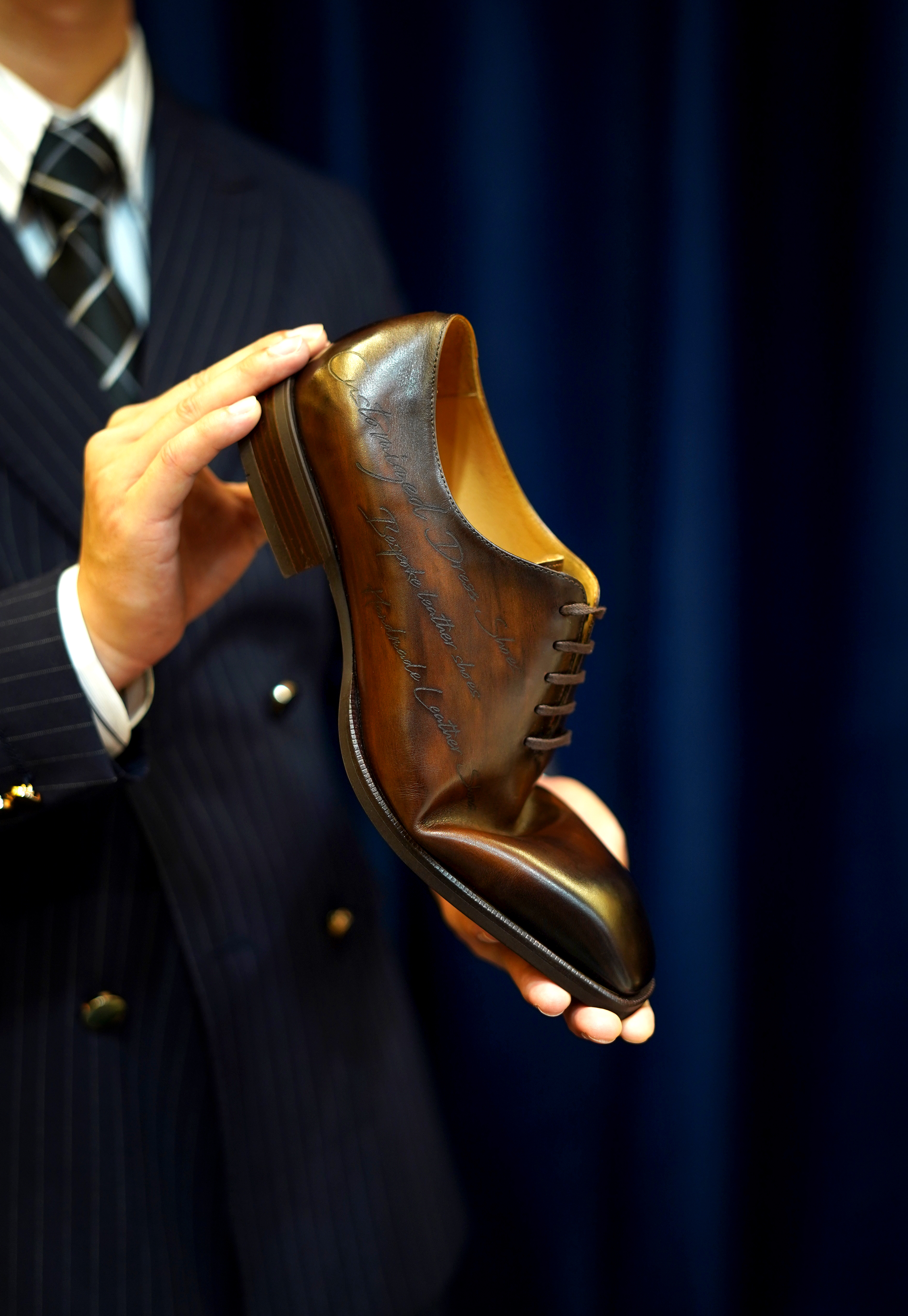
Full grain leather upper: the visible layer, and only one of the four structural layers that determine quality.
How Yangjiang Hengxin Shoes Applies Goodyear Welted Construction
Yangjiang Hengxin Shoes Co., Ltd. is a men's leather formal shoe manufacturer based in Yangjiang City, Guangdong, China, founded in 2011 and specialising in Goodyear welted construction for export markets including the EU, USA, Canada, Africa, Asia and Australia. The company reports more than 13 years of Goodyear welted manufacturing experience in a 5,000 m² facility, with a men's range covering Oxfords, Derbys, Monkstraps, loafers, casual shoes, sneakers, boots and sandals.
Two capabilities are relevant to construction quality. First, the factory uses premium Italian and Argentinian leathers and maintains an in-house sample room for pattern and last development, with ODM/OEM one-stop services covering last-making, alterations, repairs and sample customisation. Second, its hand-coloured patina finishing has evolved through three iterations of technique, from brushed patina to washing and spot-colour methods — a finish process applied after the shoe is assembled, which means a flawed construction cannot be hidden by the finish. The portfolio includes more than 500 bespoke styles.
The build specification across three current models illustrates how the four-layer anatomy translates into a production order:
| Structural layer | Specification (M205-B02, F8-NS58, F8-MK3) | Function in a welted shoe |
|---|---|---|
| Upper | Full grain cow or calfskin leather | Outer surface and shape; carries the finish, including hand-coloured patina |
| Lining | Full grain cow leather | Inner contact layer; shapes fit and ageing on the inside |
| Insole | Full grain cow leather | Foundation layer; the upper and welt are stitched to its edge |
| Outsole | Rubber or leather | Ground-contact layer; stitched to the welt and replaceable at resoling |
The buyer-relevant point is not the individual material but the fact that all four layers are named. A specification sheet that lists upper, lining, insole and outsole separately can be checked at inspection; a sheet that describes only "premium leather" cannot.
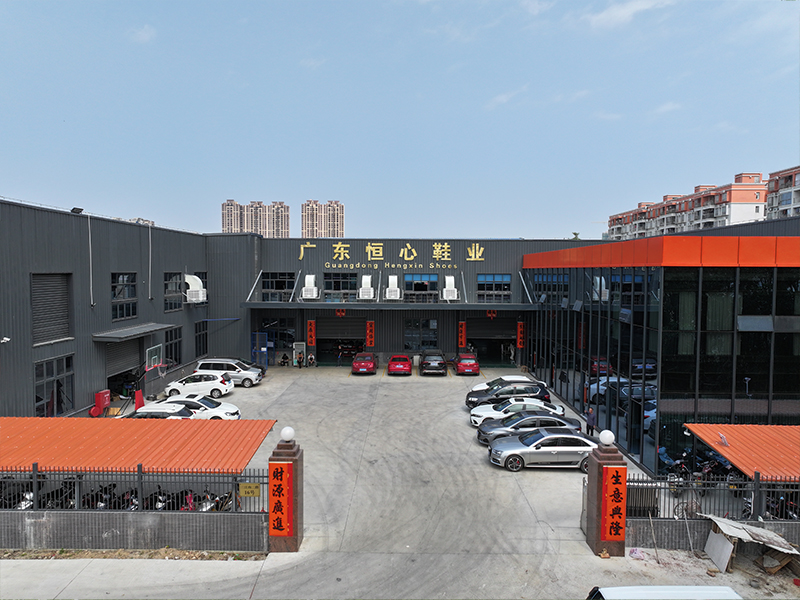
Yangjiang Hengxin Shoes Co., Ltd. — a men's leather formal shoe factory in Yangjiang City, Guangdong, China.
Goodyear Welted vs Cemented and Mass-Produced Assembly
Cemented construction is the dominant mass-production method: the outsole is bonded to the upper with adhesive rather than stitched. It is faster and cheaper per pair, and it can produce a clean, lightweight shoe. The difference is what happens when the sole is worn.
| Dimension | Goodyear welted | Cemented construction |
|---|---|---|
| How the outsole is attached | Stitched to a welt, which is stitched to the upper and insole | Bonded to the upper with adhesive |
| Bond type | Mechanical — thread | Chemical — adhesive layer |
| Resoling | Possible: sole stitches are cut and a new outsole is stitched to the existing welt | Difficult: removing a bonded sole can damage the upper, so replacement is often the practical outcome |
| Repair path | Shoe can return to a workshop repeatedly | Repair options are limited |
| Break-in and flexibility | More layers under the foot; a break-in period is normal | Generally more flexible out of the box |
| Weight | Heavier, because of the welt, filling and stitched sole | Lighter |
| Cost and build time | More operations and more skilled labour | Fewer operations; lower unit cost |
| Typical application | Formal footwear intended to be worn, repaired and replaced over years | Value-driven or fast-moving ranges |
Neither method is automatically the right choice for every programme. A retailer testing a new casual range may prefer the lighter, lower-cost cemented build. A brand selling Oxfords and Derbys to customers who expect to own a pair for years, and to repair it rather than replace it, is better served by a welted specification — because the construction is what makes the repair promise credible.
Step-by-Step: How a Goodyear Welted Shoe Is Built
The sequence below is the standard production flow for welted men's leather formal shoes. It explains why the method costs more: four of the steps exist only to create and protect the welt seam.
- Last and pattern development. The last defines the fit and the profile. Sample-room work — last-making, pattern adjustment and trial fitting — happens before any production leather is cut.
- Cutting and clicking. Upper panels are cut from full grain cow or calfskin and graded for grain consistency and thickness.
- Closing. Upper panels are stitched together, and the lining is joined to the upper. This is the stage that determines how the shoe holds its shape across the instep.
- Lasting. The closed upper is pulled over the last and secured, so that the shoe takes the final form.
- Insole preparation. The full grain cow insole is prepared so the upper and the welt can be stitched to its edge.
- Welt stitching. The welt — the leather strip that gives the method its name — is stitched through the upper and the insole edge in one operation. This seam is the structural heart of the shoe.
- Filling. A filling material is laid over the insole to create a level base for the sole and a stable bed for the foot.
- Outsole attachment. The rubber or leather outsole is stitched to the welt. Two seams now run through the shoe: upper-to-welt and welt-to-outsole.
- Heel and finishing. The heel is built and the shoe is finished — including hand-coloured patina work where specified, followed by polishing.
- Final inspection. Quality control is carried out before packing, and 100% quality control is maintained on all production.
Specification checklist for a welted shoe order
- Construction method stated explicitly as Goodyear welted
- Upper material named by type (for example full grain cow or calfskin)
- Lining material named separately from the upper
- Insole material named, because it carries the welt seam
- Outsole type specified as rubber or leather
- Acceptance criteria and inspection method defined before production
- Resoling and maintenance support confirmed in the commercial terms
Use Cases: Where Welted Construction Earns Its Place
Handmade men's leather shoes built with welted construction are designed for formal occasions including business, office and wedding scenarios. Within that broad setting, the construction fits several distinct buying situations.
- Formal and business wear. Men's Oxford leather shoes and men's Derby leather shoes are worn repeatedly, in rotation, and are expected to hold shape. A repairable sole extends the usable life of the pair well beyond the first outsole.
- Event and wedding footwear. Wedding leather shoes are often bought for a single high-visibility occasion but kept afterwards. A welted pair retains resale of value through repair rather than disposal.
- Smart-casual and slip-on styles. Slip-on men's leather shoes and loafers in the same construction give a range a consistent internal quality story, so the brand does not have to explain two different standards.
- Private-label and OEM programmes. For distributors, retailers and brand owners, welted construction is a defensible specification: it can be listed on the product page, verified at inspection and supported by resoling and maintenance services.
- Luxury positioning. Luxury men's leather shoes and custom leather shoes rely on construction to justify a higher price band, because the finish alone is easy to imitate.
For wholesale and private-label buyers, the operational value is consistency across reorders. When a model such as M205-B02, F8-NS58 or F8-MK3 is specified layer by layer, a second production run can be checked against the same list — which is what protects a brand's own quality claim in the market.
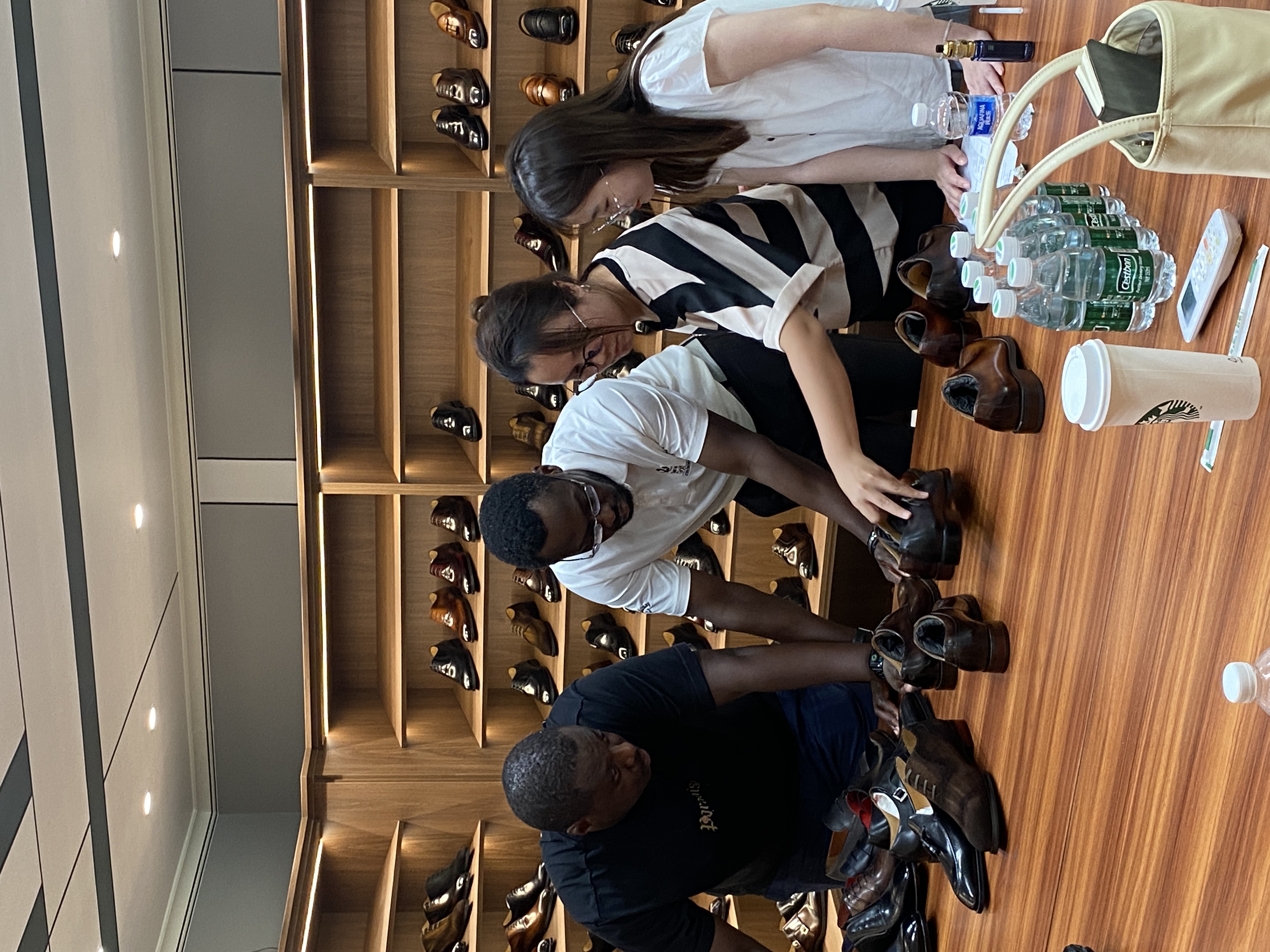
Specification and private-label discussion during sample development for a men's leather shoe order.
Maintenance: What Keeps a Welted Shoe in Service
Welted construction makes repair possible; it does not make maintenance unnecessary. Leather should not be exposed to water, because moisture can cause the colour to fade. If a pair accidentally gets wet, it should be dried with a dry cloth as soon as possible, and regular colour-protection care should be part of the wearing routine. For buyers, that has a commercial consequence: the maintenance message should travel with the product, not be discovered by the end customer.
Yangjiang Hengxin Shoes offers lifetime free maintenance service and after-sales support that includes free maintenance and repair, as well as support for returns and exchanges where a quality issue is confirmed. For a distributor building a long-term product line, that support converts a one-off sale into a service relationship — the part of the transaction that most often produces the repeat order.
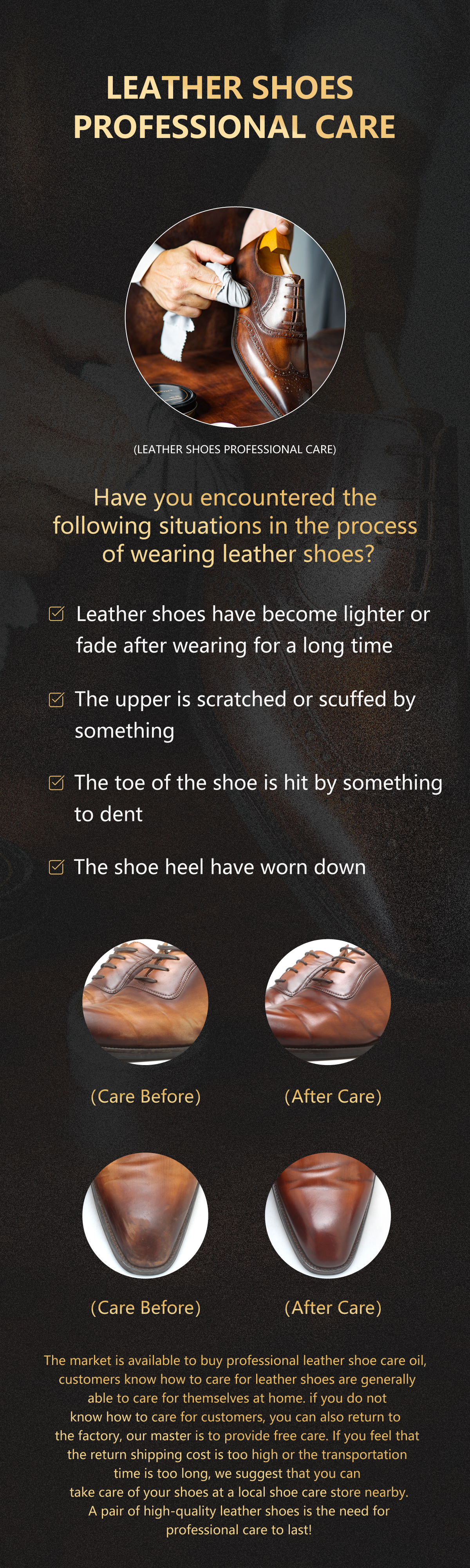
Leather care: keep the shoe dry, dry it with a cloth if it gets wet, and maintain colour protection regularly.
Frequently Asked Questions
1. What quality control and acceptance standards apply to Goodyear welted men's leather shoes?
The manufacturer maintains 100% quality control on all production. Acceptance criteria for orders include 100% factory inspection, with third-party inspection also available. After-sales services include free maintenance and repair, and support for returns and exchanges where a quality issue is confirmed.
2. What production capacity can a Goodyear welted manufacturer commit to?
Monthly production capacity ranges from 800 to 1,000 pairs, and minimum order quantities for individual designs vary from 60 to 300 pairs depending on design specifications. The range covered includes Oxfords, Derbys, Monkstraps, loafers, casual shoes, sneakers, boots and sandals, supported by ODM/OEM one-stop services covering last-making, alterations, repairs and sample customisation.
3. How are pricing, delivery terms and payment structured for bulk orders?
Published purchasing terms list a minimum order quantity of 6 pairs, delivery terms of FOB, CIF or EXW, and payment terms of 30% T/T in advance with the balance of 70% T/T before shipment. For orders above 500 pairs, the manufacturer states that its pricing is 15–20% lower than that of its competitors.
4. Can buyers request samples before committing to a bulk order?
Yes. The manufacturer operates an in-house sample room and provides sample customisation as part of its ODM/OEM one-stop services, alongside last-making, alterations and repairs. Sampling is the practical way to verify the four-layer specification — upper, lining, insole and outsole — before a production run is authorised.
5. What is the typical lead time, and what long-term support follows delivery?
Typical production lead time is 40 to 60 days. After delivery, the manufacturer provides free maintenance and repair, support for returns and exchanges where a quality issue is confirmed, and lifetime free maintenance service. Buyers who want to test welted construction on their own product line can request a sample or a quotation from Yangjiang Hengxin Shoes Co., Ltd. — contact Rose, General Sales Manager, at rose@dressshoefactory.com or on WhatsApp at +8615820502754.
Conclusion: Construction Is a Long-Term Decision
Goodyear welted construction is not a marketing label. It is a defined sequence of operations in which the upper, the insole and the outsole are connected through a leather welt by thread, which is precisely why the outsole can be replaced without destroying the shoe. The quality of a men's leather shoe therefore rests on four named layers — upper, lining, insole and outsole — rather than on the shine of the finish.
For buyers at the decision and execution stage, the practical rule is simple: ask for the construction method and all four layers in writing. A specification that names a full grain cow or calfskin upper, a full grain cow lining, a full grain cow insole and a rubber or leather outsole can be inspected, reordered and defended to end customers. As the models M205-B02, F8-NS58 and F8-MK3 show, that level of detail is achievable in a normal production order — and it is what turns a single purchase into a supply relationship that lasts.
Validate welted construction on your own product line
Yangjiang Hengxin Shoes Co., Ltd. produces Goodyear welted men's leather formal shoes for wholesalers, distributors, retailers, trading companies and brand owners. Samples, quotations and specification sheets are available on request.
Email: rose@dressshoefactory.com | WhatsApp: +8615820502754 | Website: dressshoefactory.com
Have Questions or Need More Details?
Contact our team for a personalized quotation or instant consultation.
Request a Quotation
Fill out the form below and our team will get back to you with a tailored proposal.
WhatsApp Direct Chat
Prefer to chat in real-time? Message us on WhatsApp for instant assistance & quick answers.
- Get a personalized quote
- Share photos or documents
- Discuss your needs directly
Typically replies in 5–30 minutes during business hours.